Re: The Tick Tock Effect
Posted: Sun Oct 05, 2014 1:05 pm
Wow. Well, I appreciate the bibliography, sort of. A few direct citations would have actually been better.
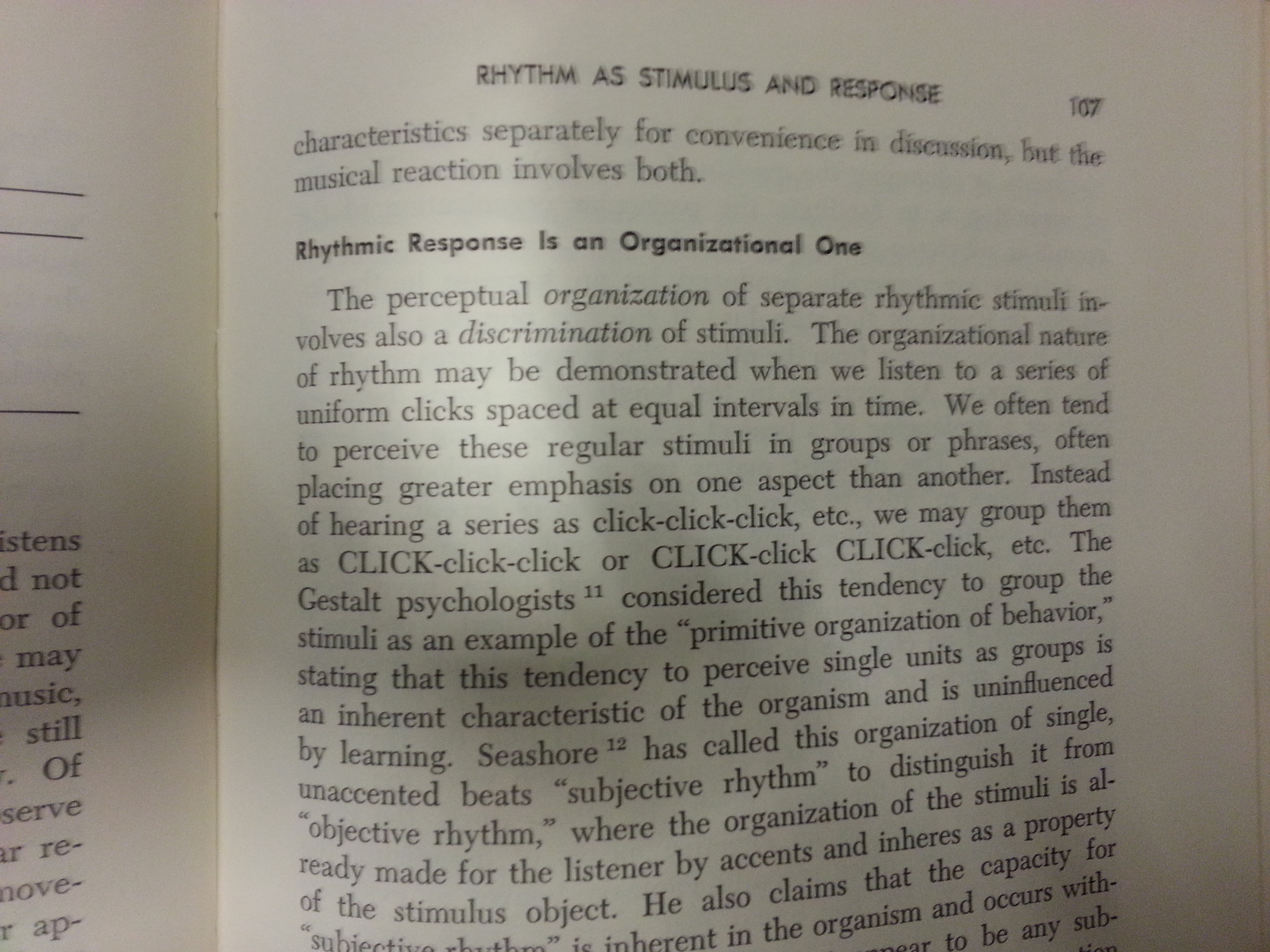
First off, let me say we're not in disagreement over theories of what defines our relation to musical time, or groove, and how the mind may be processing all of that. The problem, for me, is the example in the video of the Tick-Tock Effect. And the video is what you created the thread seeking critiques on. The problem here is that how you couched the theory makes it dependent on a clock, but a clock doesn't support the theory.
I asked how it is my brain has 'synced' by only the 2nd tick from the clock in order to conclude I am hearing two different sounds when there is "actually" only one -- according to you -- because I wanted to know how this conclusion takes place within only two sounds of a sequence. Your theory goes on to posit that my mind is so adept at this trickery that it will use it to delude me into hearing things that aren't there, and all because it has this fascination with music that is so strong that misinforming me over something as mundane as a ticking clock is not only necessary, it's just the way it is. An "actuality" as it were.
A more logical explanation for the events is that my brain is processing information from my ears at the 2nd sound in that sequence, and not concluding with what it wants me to sync to, or tricking me, or coming to a conclusion with what it has in sound-memory. I'm not saying those things aren't entering into whatever mental gymnastics are set in motion, I'm only saying that at beat two I'm confident my brain is still in information gathering mode. If, at this same beat two, I'm hearing two different sounds, it's just as likely to be because there are two different sounds. Or my ears are bad. Or sound-memory has "actually" come into play, but our brain, as you say, is so unacceptably slow in the moment that we're not cognizant it's already happening. Probably not because we're mentally slow, but because it's an abstraction to us.
Going with your "back-fill" explanation, if my mind is 'back-filling' by beat #2, one second after beat #1, that could logically be in attempt to associate it with something already in memory. The mind can also reject possibilities in an amazingly short time. Of the innumerable sounds that contain two beats in a sequence, my mind won't consider a ga-zillion of them it has processed in the past. However, a sequence at or near 60-bpm and I believe my brain is going to consider the possibility of a clock immediately, but it's going to require at least two beats for that to happen, and likely three or four to make that a self-satisfying determination. It's also going to require sounding like a clock in addition to sharing the clock's cadence. However, you would have us believe that all this trickery is set in stone by beat two because that's what we all hear with your clock example. Tick-Tock. Tick-Tock. Pure auditory illusion because there are two sounds created by our mind, but "actually" there is only one.
The trouble with everything I've written up to this point concerning your theory, and resolutely unaffected by your bibliography, is that many, many, many mechanical clocks make two sounds, and at the same cadence, and with extremely similar tone. We are conditioned to hearing a clock tick, either real or facsimile, made of exactly these two sounds at the same speed. Every time. It's universal. It's ubiquitous. If it's not the opening for 60 Minutes then it's every other clock ticking sound in the world. Once the brain considers that a sequence of sounds could well be a clock, the sound-memory of that two-tone clock is recalled, if for nothing else but comparison. And this is exactly what's happening with the metronome example I give in the reply above.
Listen to a cadence well outside the parameters of a clock and the Tick-Tock two-tones-are-really-only-one theory dissolves. Even with a picture of a clock accompanying the sound, if the sound or cadence isn't the real thing, the mind is going to reject it. Your video shows us a clock along with the sound of a mechanical clock doing what it is a mechanical clock does. But then you tell me what I've been hearing all these years isn't really there. But it is there. It's a fact.
Listen to a different tone - not reminiscent of a clock tick - (electronic tone, for example), and there is no Tick-Tock Effect, even at smack on 60-bpm. Don't think so? have at it once you are set to 60
http://www.8notes.com/metronome/
In fact, we could play whack-a-theory all day. Think of the human heartbeat for a few moments, or your own. Now, set a standard metronome (as in my earlier post) to 138-144, or double your own heartbeat. We'll hear two slightly different sounds weaving in and out of one sound per each two beat sequence, won't we? Sounds amazingly like a heartbeat if we stretch out a little. We can add this power of suggestion example to the list and have yet another theory. Let's bundle them all up and call it The "My Brain Can Do Some Amazing Shit" theory. I'd buy that book.
First off, let me say we're not in disagreement over theories of what defines our relation to musical time, or groove, and how the mind may be processing all of that. The problem, for me, is the example in the video of the Tick-Tock Effect. And the video is what you created the thread seeking critiques on. The problem here is that how you couched the theory makes it dependent on a clock, but a clock doesn't support the theory.
I asked how it is my brain has 'synced' by only the 2nd tick from the clock in order to conclude I am hearing two different sounds when there is "actually" only one -- according to you -- because I wanted to know how this conclusion takes place within only two sounds of a sequence. Your theory goes on to posit that my mind is so adept at this trickery that it will use it to delude me into hearing things that aren't there, and all because it has this fascination with music that is so strong that misinforming me over something as mundane as a ticking clock is not only necessary, it's just the way it is. An "actuality" as it were.
A more logical explanation for the events is that my brain is processing information from my ears at the 2nd sound in that sequence, and not concluding with what it wants me to sync to, or tricking me, or coming to a conclusion with what it has in sound-memory. I'm not saying those things aren't entering into whatever mental gymnastics are set in motion, I'm only saying that at beat two I'm confident my brain is still in information gathering mode. If, at this same beat two, I'm hearing two different sounds, it's just as likely to be because there are two different sounds. Or my ears are bad. Or sound-memory has "actually" come into play, but our brain, as you say, is so unacceptably slow in the moment that we're not cognizant it's already happening. Probably not because we're mentally slow, but because it's an abstraction to us.
Going with your "back-fill" explanation, if my mind is 'back-filling' by beat #2, one second after beat #1, that could logically be in attempt to associate it with something already in memory. The mind can also reject possibilities in an amazingly short time. Of the innumerable sounds that contain two beats in a sequence, my mind won't consider a ga-zillion of them it has processed in the past. However, a sequence at or near 60-bpm and I believe my brain is going to consider the possibility of a clock immediately, but it's going to require at least two beats for that to happen, and likely three or four to make that a self-satisfying determination. It's also going to require sounding like a clock in addition to sharing the clock's cadence. However, you would have us believe that all this trickery is set in stone by beat two because that's what we all hear with your clock example. Tick-Tock. Tick-Tock. Pure auditory illusion because there are two sounds created by our mind, but "actually" there is only one.
The trouble with everything I've written up to this point concerning your theory, and resolutely unaffected by your bibliography, is that many, many, many mechanical clocks make two sounds, and at the same cadence, and with extremely similar tone. We are conditioned to hearing a clock tick, either real or facsimile, made of exactly these two sounds at the same speed. Every time. It's universal. It's ubiquitous. If it's not the opening for 60 Minutes then it's every other clock ticking sound in the world. Once the brain considers that a sequence of sounds could well be a clock, the sound-memory of that two-tone clock is recalled, if for nothing else but comparison. And this is exactly what's happening with the metronome example I give in the reply above.
Listen to a cadence well outside the parameters of a clock and the Tick-Tock two-tones-are-really-only-one theory dissolves. Even with a picture of a clock accompanying the sound, if the sound or cadence isn't the real thing, the mind is going to reject it. Your video shows us a clock along with the sound of a mechanical clock doing what it is a mechanical clock does. But then you tell me what I've been hearing all these years isn't really there. But it is there. It's a fact.
Listen to a different tone - not reminiscent of a clock tick - (electronic tone, for example), and there is no Tick-Tock Effect, even at smack on 60-bpm. Don't think so? have at it once you are set to 60
http://www.8notes.com/metronome/
In fact, we could play whack-a-theory all day. Think of the human heartbeat for a few moments, or your own. Now, set a standard metronome (as in my earlier post) to 138-144, or double your own heartbeat. We'll hear two slightly different sounds weaving in and out of one sound per each two beat sequence, won't we? Sounds amazingly like a heartbeat if we stretch out a little. We can add this power of suggestion example to the list and have yet another theory. Let's bundle them all up and call it The "My Brain Can Do Some Amazing Shit" theory. I'd buy that book.